Tuesday, 4 June 2013

Raasay Iron Ore Mine, 8 January 2013

We were on the island of of Raasay on a cold, sombre winter day to look at the remains of an iron ore mine where in the first world war German prisoners worked in a process that would ultimately produce weapons with which their fellow countrymen were killed. This was in contravention of the Hague Convention. At the end of the war many of the prisoners never returned home, having died from infectious diseases. The price of iron ore on the world market slumped and the mine was closed because it was no longer profitable.

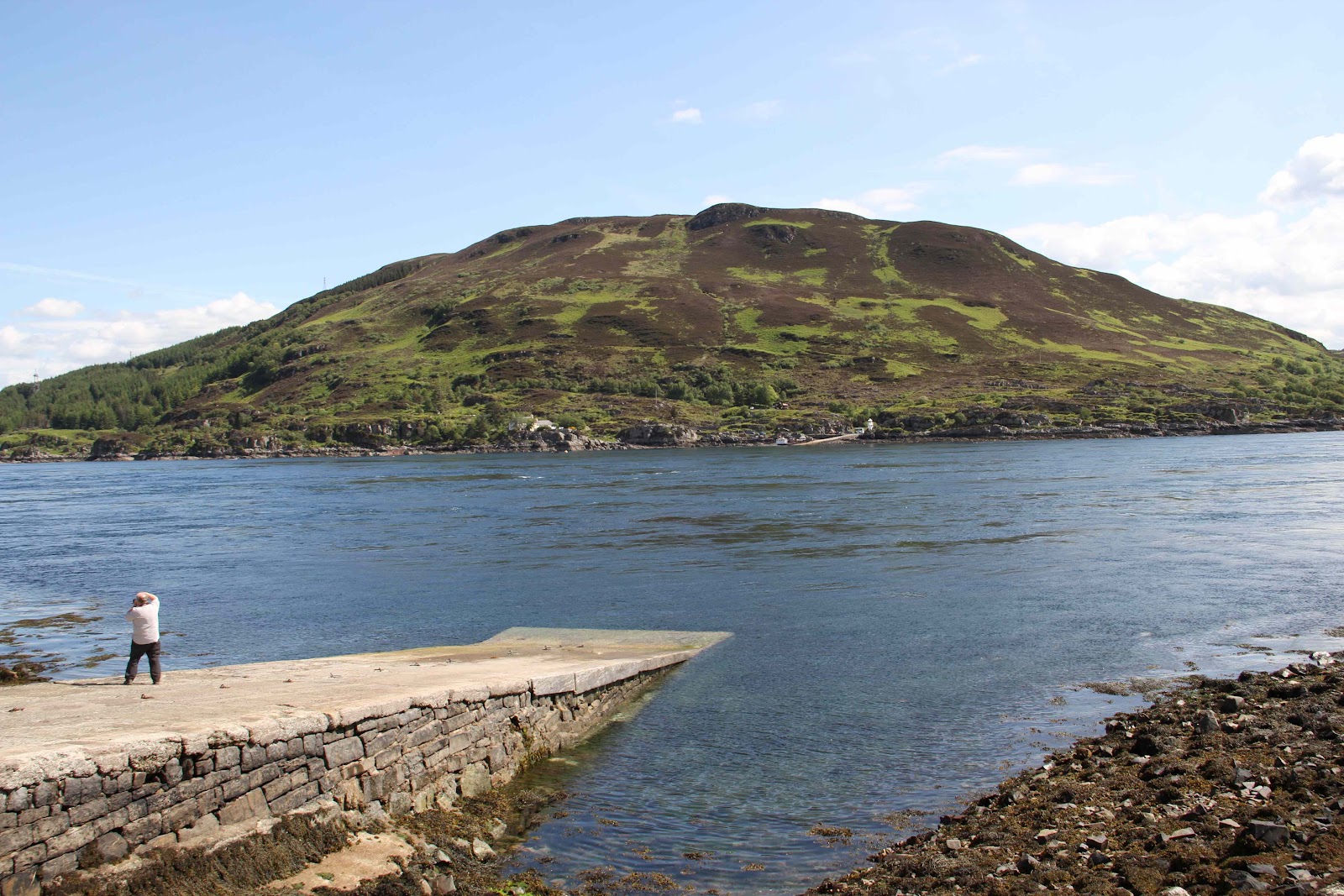
Having arrived on the ferry. 


 Looking back to Skye.


The furnaces where crude iron ore was partly enriched before being loaded into a huge storage hopper from where it was shipped.


 Looking along the line of furnaces.


 The support columns marking the line of the small railway along which the crude ore was transported from the mine to the furnaces.


The remains of a mining building.


This may be the closest we got to the actual ore seam. We weren't sure what it was.


A quick sandwich and coffee before rushing back for the final daylight ferry.

Wednesday, 6 March 2013

The Moine Thrust

2 October 2012
 
The A890 south of Achmore apparently traverses the Moine Thrust which is exposed in a cutting through a small hill. The rock is largely made up of Moine Schists which were formed metamorphically from sedimentary rocks when the Iapetus Ocean closed as the continental land masses Laurentia (North America), Avalonia (Europe), and Baltica collided, with Scotland being on the front line of this massive coming together. Following the heat, pressure, and folding, the rocks recrystallized as thin sheets (foliation or schistosity). Schists are said to comprise platy minerals such as mica, chlorite, amphibole, and talc.
 
Here's a section of the exposed rock. If you look closely you will see the fine sheet-like layers.
 
 
Notice too how although the bulk of the rock appears a shiny grey, typical of mica schist, there are also areas in which the predominant colour is pale green which maybe indicates the presence of more chlorite schist. There is also a seam of some quartz-like mineral cutting through the schist.


A rather interesting bright red mineral seeping through pores in the rock, or a recent murder scene.
 
 
A band of iron mineral-containing rock.
 
 
I wonder if some of this reddish stuff is garnet-mica schist.


A bunch of local chavs on there way to a hidden dell with their bags of bucky, cheap cider, and various assorted solvents.


Interesting!
 
 
Looking back south towards Loch Alsh.
 
 
Lunch at Plockton
 
 
All geological assertions in this blog must be taken with half a teaspoon of smoked paprika.


Sunday, 2 December 2012

Kilmuir Cliffs and the Cave of Gold

17th July 2012

The cliffs of Kilmuir are high up on the north west of the Trotternish Peninsula on the Isle of Skye. They are said to be volcanic sills, horizontal undergound lava flows which formed vertical joints as they cooled.


Peering down over the steep gully leading into the Cave of Gold.


The Cave of Gold, with a bloody glow reminiscent of its birth from red hot magma fifty eight million years ago.


More magmatic columns ....


..... some providing homes for itinerant ex-dinosaurs.


Closer to the water the volcanic sill has been partly eroded away by wave energy, giving us a cross sectional view of the columns formed during cooling, in this case with a square outline.


Now the cross sections are oblong, with a basaltic darkness.


 And these are trendng towards the hexagonal.


 Sea stacks; laval columns awaiting downfall through the perpetual tickle of waves, nudging of wind, and bear hug of gravity.
  

I'm not totally convinced that these hugely vertical structures are really the result of horizontal underground intrusions of magma but it was a great day out, despite the absence of giant cabbage leaves.

Monday, 10 September 2012

Sheena's pretty rocks day

Five of us went in search of "some really nice rocks" at Glenelg on 5th June 2012.

Looking eastward from the Isle of Skye across Kyle Rhea to the beach at Bernera, near Glenelg on the Scottish mainland.


Looking across Kyle Rhea at the crossing of the Glenelg ferry. There's a very rapid current here.


The wee ferry on its way


Looking back at the granite intrusions on Skye


The estuary of the River Glenmore


And so to the rocks on the pebbly beach at Glenelg.

An igneous rock with iron-containing minerals


To me this looks like layers of marble (with a pink mineral) in a grey sedimentary rock. This might be true if it's possible that limestone can leach into crevices in sedimentary rocks or is an actual sedimentary layer itself, and that the pressure (and associated heat) created by subsequently accumulating sedimentary layers is sufficient to convert the limestone to marble. It's more likely perhaps that the marble (if it is marble - I think Jo suggested it was something else) was created through heat transmitted from an adjacent igneous intrusion, which would mean that the grey rock, in spite of its layered appearance, is igneous. From the platform of almost total ignorance one can speculate almost indefintely and equally fruitlessly about the most trivial of geological observations. But therein lies the fun and the frustration. Judy has since stated that the seams in this and the following image comprise quartz, formed from the oxidation of silica-containing solutions.


More of the same. What I don't understand is how one can get layers of marble within igneous rocks. One would imagine that the marble is formed in bulk at the aureole (zone of heat transference) around the igneous intrusion, though perhaps in this region there is some interpenetration of the magma and limestone.


Speculations invited


The orange material is lichen but the pink is a mineral.


A closer look at the pink-red mineral which has been allocated a variety of speculative identifications by members of the group, with Jo proposing biotite and Faye stilbite.


 Perusing pebbles


Many of the pebbles were coated with tiny particle of shiny material, moreso than the one above. Faye says the material is mica.


Same pebble


Looks like a conglomerate


On the way back, looking north east over the eastern end of Loch Duich, we spy the Giant's Hand, which I think is substantially bigger than Jo's Lion.